
What We Believe

Mark Ramsay, Principal

I’m pleased to share that in my time here over the last two and a half years, I’ve never heard a parent ask, “Oh, you teach about Jesus here? I didn’t realise this was that kind of school.”

At every enrolment interview, and indeed in every conversation I have with parents considering Kuyper for their children, I am very clear that Kuyper is a Christian school. If there is one thing that I want to ensure that all parents fully grasp, it is that all the staff at Kuyper hold to our faith in Jesus with the utmost commitment. Every staff member at Kuyper is a follower of Jesus, and we all view our work at Kuyper as service of Him. 

Jesus’ life, death and resurrection change everything. They change our view of ourselves, our relationships, and how we live. They also change our approach to running a school. There is nothing outside of the scope of Jesus’ Lordship. What we teach in our classrooms, how we maintain our facilities, the compassion with which we care for unwell students, the way we drive the school vehicles, and the integrity with which we manage our finances – Jesus claims authority over all these things. As a school, we seek to honour Jesus in every part of every day. This is what we believe. This is what we hold firmly to.

It is also true that we are an open-enrolment school. This means that we recognise that our student and parent community includes a variety of faith and lifestyle beliefs. Let me be very clear—all are welcome in our school. We recognise the right of parents and students to hold different positions on lifestyle or faith as private matters. Nevertheless, it is important that families who join our school community understand and support what the school promotes, practices, and teaches. 

The founders of Kuyper wrote a Statement of Faith to ensure that all members of the school community understood the beliefs they held to be of the highest importance. Upon enrolment, all parents are asked to acknowledge that they have read and understood this Statement of Faith.

At the recent Annual General Meeting, the Kuyper Christian School Association voted to accept an updated version of the Statement of Faith. It does not contain new beliefs and continues to acknowledge Jesus’ Lordship over all things. However, the language has been amended, which should help convey meaning more clearly. I encourage you all to read this new Statement of Faith to ensure that you continue to understand what Kuyper promotes, practices, and teaches.

If you have any questions about Kuyper’s Statement of Faith, I encourage you to raise them with me or a member of the Board. Please do not hesitate to make contact via the school office on 4573 2999 or admin@kuyper.nsw.edu.au. We would love the opportunity to discuss any questions you may have over a cup of tea or coffee.


Stay & Pray

What an incredible privilege it is to be able to bring all our requests before the living God.

Parents and friends of Kuyper Christian School are invited to Stay & Pray with us each Thursday morning from 9 AM to 10 AM in the Prep room.

Please join us in strengthening our school community by lifting this place and its people up to our good, generous God.

Be devoted to one another in love. Honor one another above yourselves. 
Never be lacking in zeal, but keep your spiritual fervor, serving the Lord. 
Be joyful in hope, patient in affliction, faithful in prayer.

Romans 12:12

Term 2 Dates
2 May
9 May
16 May
23 May
30 May
6 June
13 June
20 June
27 June
4 July

On Being Counter-Cultural

Mark Ramsay, Principal

In the face of what seems to be an unrelenting cultural assault on our young people, what can we do?

This was the question that a room full of parents and community members were confronted with on Monday night as renowned speaker Melinda Tankard Reist (founder of Collective Shout) presented parents with a disturbingly long list of examples of the sexualisation of contemporary youth culture. I am sure I was not alone in feeling shocked at what our children and young people see in advertising, music, movies, gaming and social media. 

At Kuyper, we desire for our students to grow up confident in the knowledge that God knows and loves them and that their value does not lie in a particular form of ‘attractiveness’ to another. We also want them to be other-centred, understanding how to act with integrity and treat others with respect. 

So, the question is confronting: In the face of what seems to be an unrelenting cultural assault on our young people, what can parents and educators do? Is it a hopeless situation?

Awareness is crucial, and there are many practical things that parents can do to help their children navigate the particular dangers of the digital world. The Australian Government eSafetyparents site is a great place to start, and many other excellent resources are available for parents. I’ve included a list of recommended readings below.

There is no doubt that the task is daunting. However, as Christians, we have good reason for hope. We know that we are not alone in navigating this world. Jesus promised to be with his followers at all times (Matthew 28:20) and that the Holy Spirit would be a helper for them (John 14:16). 

Even more, we know that Jesus is the victor over all the challenges confronting us in this world. He encourages us to “take heart! I have overcome the world.” (John 16:33). Whatever evil and sinfulness we see around us, we can have great confidence that Jesus’ death and resurrection have achieved victory over all things, including this sexualised culture.

So, let me encourage you to do three things:

  1. Be aware – know what your children are viewing and doing.
  2. Talk to one another and to us – we are stronger together.
  3. Pray for all young people, particularly those in our community.
    Pray that they will know that their value is not determined by their external appearance; pray that they will not be tempted to focus entirely on the online world; and pray that they will know that God’s love for them is greater than any other force or experience in this world.
Recommended Reading

Raising Resilient Kids
From Collective Wisdom Publications
With contributions from Michelle Mitchell, Michael Carr-Gregg, Melinda Tankard Reist, Danielle Miller, Wendy Mason, Hugh Van Cuylenburg, Susan McLean, Sharon Witt and Micheal Gross. 
Available from Koorong.

How to Talk to Your Kids About Pornography, Second Edition
From Educate and Empower Kids, Dina Alexander and Jera Mehrdad (Illus)
Available from Booktopia.

Good Pictures. Bad Pictures, Second Edition
By Kristen Jensen and Debbie Fox (Illus)
Available from Koorong.

Raising Tech Healthy Humans
By Daniel Sih
Available at a special price through Christian Education National.

Stay & Pray

What an incredible privilege it is to be able to bring all our requests before the living God.

Parents and friends of Kuyper Christian School are invited to Stay & Pray with us each Thursday morning from 9 AM to 10 AM in the Prep room.

Please join us in strengthening our school community by lifting this place and its people up to our good, generous God.

Be devoted to one another in love. Honor one another above yourselves. 
Never be lacking in zeal, but keep your spiritual fervor, serving the Lord. 
Be joyful in hope, patient in affliction, faithful in prayer.

Romans 12:12

Term 2 Dates
2 May
9 May
16 May
23 May
30 May
6 June
13 June
20 June
27 June
4 July

Growing Great Readers: Part #2

Kaelene McCaull, Head of P-6 and Director of Teacher Development

Last week, I discussed the science of reading and its five fundamental elements: Phonemic Awareness, Phonics, Fluency, Vocabulary, and Comprehension.

Reading is a complex skill, and our reading programs at Kuyper teach these essential elements explicitly and systematically, progressively building students’ literacy competency.

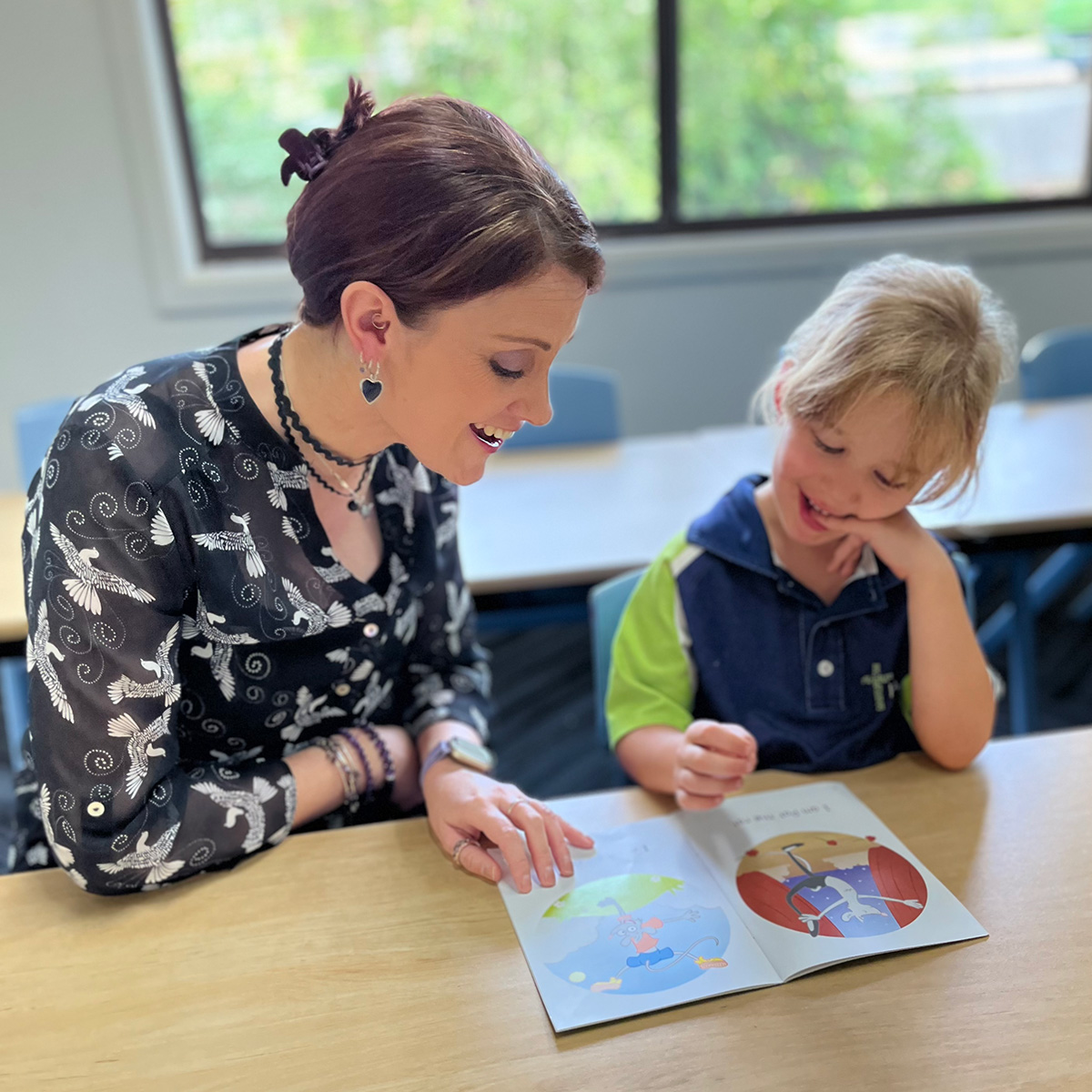
Practice is fundamental to building reading skills. Students in K-2 at Kuyper use books called ‘Decodables’ to practise their reading. First, students learn the code for various sounds and then practise blending them into words. Then they tackle reading a ‘decodable’, which contains words comprised of the sounds for which they have learnt the code. Early readers start with short CVC (consonant, vowel, consonant) words like ‘cat’. The length of the words increases as students learn more of the sound combinations and the letters that represent them. 

This approach puts the student in the driver’s seat by equipping them with skills to decode unfamiliar words in the text. Working out unfamiliar words independently gives students a greater chance of remembering them the next time they see them.   

The two short videos below are produced by SPELDNSW and provide some great tips for reading decodable text with your child at home. The first video deals with reading regular words, i.e. words the student knows all the sounds for. The second deals with reading irregular words, i.e. words with unfamiliar spelling the student doesn’t recognise yet or less common sound combinations like ‘the’ and ‘says’.

Helping your child read regular words

Helping your child read irregular words

Once your child can confidently decode words, they need to keep practising reading these words to build their Fluency. In our lessons at school, we describe this as making our reading ‘smooth like talking’. You should expect your child to be able to read all the words in some of the readers they bring home. This practice will develop fluency. Fluent reading enables students to use their focus and cognitive energies to understand what they are reading rather than working out what each word says.  

In addition to listening to your children practice reading their decodables at home, there are many other things parents can do to encourage and support the development of reading skills: 

Read to your children
In particular, read books your child cannot yet read for themselves. This builds Vocabulary and develops interest and enjoyment in reading. As you read, predict what might happen next and discuss the sequence of events or reasons behind actions. For example,

“Why do you think they did that?” or “How do you think such and such a character will react?”

Ask questions
Check that your children have understood what they (or you) have read and encourage them to ask questions. This builds Comprehension, which is a much harder cognitive skill and will take lots of practice. If children ask a question not answered in the text, you could pretend to look for it and say something like,

“I don’t know. It doesn’t tell me in the book, but if I were the character, I would…”

Read Fiction and Non-Fiction 
This helps children understand that we can read to learn about new things or things we are interested in. Some children prefer reading and hearing non-fiction books. All reading is beneficial.

Use and explore language
Talk about what you see happening in the world around you and look for opportunities to introduce new words into your discussion. This will allow your children to hear new words in context and ask you about their meaning. Students with a greater vocabulary better understand what they are reading.

Let them see you reading in real life
For example, reading a recipe or instructions and using a Google search to learn about something.

Celebrate your child’s successes
Whether it be reading a new book, sticking with it when it is challenging, or as small as mastering one tricky word, success breeds success. Remember, mastery of reading is a lifelong skill that supports all students’ future learning in whatever subjects they are studying.

Building literacy skills truly is a home-school partnership. Please talk with your child’s teacher if you have any concerns or questions, but also share your child’s successes with us so that we can celebrate together.

Stay & Pray

What an incredible privilege it is to be able to bring all our requests before the living God.

Parents and friends of Kuyper Christian School are invited to Stay & Pray with us each Thursday morning from 9 AM to 10 AM in the Prep room.

Please join us in strengthening our school community by lifting this place and its people up to our good, generous God.

Be devoted to one another in love. Honor one another above yourselves. 
Never be lacking in zeal, but keep your spiritual fervor, serving the Lord. 
Be joyful in hope, patient in affliction, faithful in prayer.

Romans 12:12

Term 2 Dates
2 May
9 May
16 May
23 May
30 May
6 June
13 June
20 June
27 June
4 July

Open Day

Saturday 31 August

9 AM to 1 PM

Curious about Kuyper or interested in enrolling? Come and explore our Prep to Year 12 learning community for yourself.

Take a tour of the school, visit classrooms and chat with staff.

Learn about:

  • our evidence-based literacy and numeracy programs for K-6 students,
  • how our Prep program prepares children for a smooth transition to Kindergarten,
  • how our Kurrajong Program is growing learners and inspiring leaders, and,
  • how specialist teachers from Kindergarten to Year 12 provide quality learning experiences across all age groups.

We have been taking Christian Education seriously for over forty years. Discover the difference it makes to have Jesus as the heartbeat of your child’s education from start to finish.

Growing Great Readers: Part #1

Kaelene McCaull, Head of P-6 and Director of Teacher Development

Partnership with parents is important to us at Kuyper as we work to support you in the education of your precious children. This partnership enhances all learning but is especially the case when it comes to building the essential skill of literacy.

When we use the term literacy in an educational context, we are not just talking about reading. Literacy learning involves reading, writing, spelling, handwriting, grammar, and speaking and listening. Sounds like a lot, doesn’t it? 

It is! That is why we dedicate a significant part of every primary school day at Kuyper to explicit literacy learning and weave literacy skills into all the subjects taught from Kindergarten to Year 12. 

Over the next two weeks, I would like to focus on the literacy skill of reading, specifically, how we teach reading at Kuyper and how parents can support their children’s learning in this vital area.

Reading is a crucial skill. It affects every area of learning and has a significant impact on our ability to engage with others and the world around us. Reading helps us learn new information and share ideas, new knowledge, and events happening around us. It helps us to function independently in society and can be a source of much enjoyment.

Importantly, reading allows us to personally interact with God’s word, the Bible, and to hear and understand Him for ourselves.

Different nations have undertaken three very extensive studies into how children learn to read. In 2000, the USA conducted ‘The National Reading Panel’; in 2005, Australia conducted the ‘National Inquiry into the Teaching of Literacy’; and in 2006, the UK undertook an ‘Independent Review of the Teaching of Early Reading’. Interestingly, all three studies arrived at the same findings about the fundamental elements of learning to read. This research, along with many other studies, now form a body of research known as the Science of Reading

The research behind the science of reading identifies five fundamental elements of reading that students must be explicitly taught to become competent readers.

Phonemic awareness
The ability to identify and manipulate individual sounds (phonemes) in spoken words.

Phonics
The relationship between the sounds of the spoken language (phonemes) and the letters (graphemes) or groups of letters or syllables of the written language.

Fluency
Both the pace at which we read and the smoothness with which we read. It involves skills like pausing at the correct places and using appropriate expression.

Vocabulary
The words students know, understand, and use.

Comprehension
The strategies and skills students possess to understand the words they are reading and how they connect to form ideas and messages

Our reading programs at Kuyper are designed to cover all five of these essential elements. They are taught in an explicit and systematic way, progressively building on easier skills to develop more complex skills. But, like any complex skill, practice makes perfect! Reading and writing are very complex skills, and children will need several years to develop into proficient readers and writers. In this area, parent partnership is a tremendous benefit to your children. The more reading practice we provide for our children at home and school, the more we help them develop and master reading skills. 

Reading is an incredible skill we have the privilege of teaching our children. Next week, I will discuss the specific learn-to-read program we use in our K-2 classes at Kuyper and how parents can support their children’s literacy learning at home.

End of Term Whole-School Assembly

Friday 5 July

2:35 PM to 3:25 PM

Parents and friends are warmly invited to a Whole-School Assembly on the last day of Term 2, Friday, 5 July, commencing at 2:35 PM. Hear from staff and students about some of the rich learning experiences our students have participated in so far this year.

Come early for Parent Connect outside the Hall from 2:00 PM (or inside the Hall if it’s cold and rainy). Catch up over coffee before the school holidays. We’d love to see you!

* Wear a Christmas sweater and join in our Christmas in July fun!

Melinda Tankard Reist: Free Parent Workshop

Monday 3 June

6:00 PM to 7:30 PM

Navigating a S*xed-Up World:
How we can help our young people resist harmful messages from media and pop culture and aspire to respectful relationships.

On Monday, June 3, Kuyper Christian School will host a FREE Parent Workshop with Melinda Tankard Reist, renowned author, speaker, media commentator, thought leader, and campaigner for cultural change.

Parents and caregivers are noticing children seem to be growing up too fast, worried about their appearance and more aware of se*ual issues at earlier ages. Children and young people are bombarded with hyperse*ualised messages from media and popular culture. The lives of young people are increasingly socialised, conditioned and informed by exposure to online p*rn before their first kiss. Drawing from current global literature and the experiences of young people, Melinda will explore how the proliferation of s*xualised images and messages contributes to a distorted view of bodies, relationships and se*uality, hampering their healthy physical, emotional and social development. She will help parents address this toxic culture and provide practical tips on raising happy, healthy and resilient young people who value their dignity and self-worth and aspire to relationships based on respect and authentic connection. She will be joined by her colleague, educator, and youth advocate Daniel Principe, who will share his work with young men, helping them understand how they are being harmed by damaging cultural messages about masculinity and encouraging them to be upstanders and not bystanders.

Parents, grandparents, caregivers, and friends will leave this session with clarity of understanding and authentic strategies for helping their children.

Melinda is probably the world’s best presenter on the damage advertisers and pornography do to our children and teens – often when we don’t even know. Her highly visual presentations will knock your socks off. You will be left angry in the very best way and be so much better equipped to talk to, and protect, your kids.

Steve Biddulph AM, Author Raising Girls and Raising Boys

Don’t miss this valuable opportunity to engage with one of Australia’s foremost speakers addressing the toxic culture our children are growing up in.

Grandparents, friends and other interested parents are welcome to attend this workshop.

Note: This session is not suitable for children under the age of 18 years.

Melinda Tankard Reist
Author, Speaker, Advocate

Melinda is an Australian author, speaker, media commentator, and advocate for young people. She is best known for her work addressing s*xualisation, objectification, harms of p*rnography, s*xual exploitation, trafficking and violence against women. Melinda is the author/editor of seven books (number eight on boundary-setting for girls forthcoming) covering the se*xualisation of young people, the harms of the p*rn/sex industry and violence against women and girls. Melinda has appeared on ABC’s Q&A, The Gruen Sessions and many other TV and radio programs. She is co-founder of the grassroots campaigning movement Collective Shout: for a world free of s*xploitation.

Melinda is an Ambassador for World Vision Australia, Compassion Australia, Hagar NZ and the youth mentoring body the Raise Foundation. She is also a Senior Lecturer at the Centre for Culture and Ethics, Notre Dame University, Sydney and has been named in the Who’s Who of Australian Women and the World Who’s Who of Women.

Daniel Principe
Youth Advocate & Educator 

Daniel is an Australian youth advocate and educator. He has a background in PR, marketing, and media and is a health professional and advisor in the non-profit health sector. Daniel challenges toxic messages about masculinity in mainstream culture, which he critiques through a p*rn-critical lens. He helps young men to see how these cultural forces fuel distorted ideas and attitudes about bodies, relationships and s*xuality. Daniel works with young men to reimagine masculinity and embody a vision of manhood defined by virtue.

Enquiries: Ruth Thompson, (02) 4573 2999 or admin@kuyper.nsw.edu.au

Stay & Pray

What an incredible privilege it is to be able to bring all our requests before the living God.

Parents and friends of Kuyper Christian School are invited to Stay & Pray with us each Thursday morning from 9 AM to 10 AM in the Prep room.

Please join us in strengthening our school community by lifting this place and its people up to our good, generous God.

Be devoted to one another in love. Honor one another above yourselves. 
Never be lacking in zeal, but keep your spiritual fervor, serving the Lord. 
Be joyful in hope, patient in affliction, faithful in prayer.

Romans 12:12

Term 2 Dates
2 May
9 May
16 May
23 May
30 May
6 June
13 June
20 June
27 June
4 July