
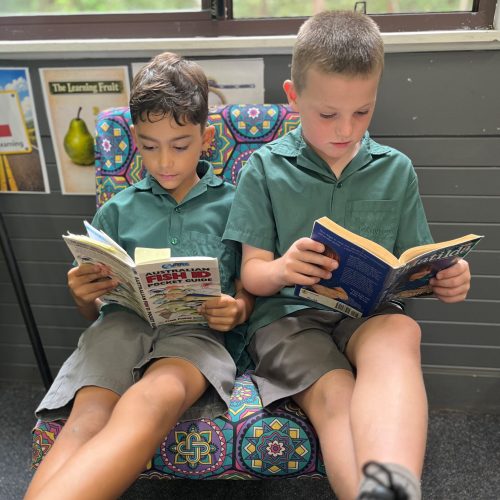
Kaelene McCaull, Head of Primary
There is a poem about reading that I love. It goes like this:
I opened a book, and in I strode
Now nobody can find me.
I’ve left my chair, my house, my road,
My town and my world behind me.
I’m wearing the cloak, I’ve slipped on the ring,
I’ve swallowed the magic potion.
I’ve fought with a dragon, dined with a king
And dived in a bottomless ocean.
I opened a book and made some friends.
I shared their tears and laughter
And followed their road with its bumps and bends
To the happily ever after.
I finished my book and out I came.
The cloak can no longer hide me.
My chair and my house are just the same,
But I have a book inside me.
— I Opened a Book, Julia Donaldson (2004)
For me, this poem beautifully captures the imaginative power of reading—the way a book can draw us into new worlds, introduce us to fresh ideas, and help us encounter places and people we might otherwise never know.
Creating and reading written and visual texts are among the primary ways we use our God-given imagination and creativity to share ideas, experiences, and stories with one another. The ability to read and write allows us to benefit from the knowledge and imagination of others, and to share our own in return.
Above all, our God has chosen to speak to us through His Son, Jesus. In our time in history, this message is communicated through God’s written Word, the Bible. Being able to read and understand the Bible for ourselves is a great privilege—one that people in past generations have not always enjoyed.
Reading is also an essential life skill. It enables us to function well in our world, both at school and beyond. Every school subject, including Maths and PDHPE, requires reading at some point in order to learn, understand instructions, or deepen knowledge. Unfortunately, simply being around books does not teach children how to read. This is why activities that provide opportunities for practising reading are a regular part of our homework in primary school.
Reading and comprehension skills are not just for primary students. As children move into secondary school, the texts they encounter become increasingly complex, with higher-level vocabulary and more challenging concepts. These skills are worth developing and strengthening throughout the school years, even though the ways we practise them will change as children grow.
As partners with us in your child’s education, your attitude towards reading—and homework more broadly—has a powerful influence. Do your children see reading as something valuable and worth their time and effort? Do your conversations and daily habits encourage them to value the opportunity to practise and build these important skills?
For families with younger children who are still developing their reading skills, there are many simple and effective ways you can support them at home:
Read to your children
In particular, read books that your child cannot yet read independently. This helps build vocabulary as you pause to discuss new or interesting words together.
Reading just one picture book a day in the five years before school exposes a child to an estimated 1.4 million more words than children who are never read to. Research consistently shows that students with a wider vocabulary have greater success in understanding what they read and in learning more broadly.
Reading aloud also nurtures enjoyment and interest in reading. As you read together, make predictions about what might happen next, discuss the sequence of events, and explore the reasons behind characters’ actions. These strategies help children develop comprehension and deeper thinking skills.
Ask questions
Check that your child has understood what they (or you) have read, and encourage them to ask their own questions. This is a challenging cognitive skill and takes time and practice, but it is a powerful way to deepen understanding.
Read both fiction and non-fiction
This helps children understand that reading can be for enjoyment as well as for learning. Explore your child’s interests through books on topics they love. Some children prefer non-fiction texts, and that is perfectly fine—all reading is valuable.
Swap screen time for story time once a day
Setting aside even a short, regular time each day to replace screens with reading can make a meaningful difference. Screens tend to encourage quick, passive consumption, while reading requires focus, imagination, and active engagement. By intentionally creating space for reading—whether independently or together—you help your child build concentration, develop language skills, and discover the quiet enjoyment that books can offer.
Build reading into everyday routines, such as bedtime or breakfast.
When reading becomes part of the natural rhythm of family life, it is more likely to be seen as normal and worthwhile. Simple, consistent habits—like a chapter before bed or a short Bible devotional over breakfast—help children practise regularly without it feeling like an added burden. Over time, these small, repeated moments build confidence, fluency, and a growing sense that reading is a valued and enjoyable part of daily life.
Let your children see you reading
Modelling matters. This might include reading a recipe or instructions, or using Google Search to learn something new. While these activities do not replace the need for children to practise reading independently, they provide wonderful support for the important and challenging work they are doing as they learn this essential skill.
What will you and your children be reading these holidays?